Roof Moss in the Pacific Northwest: Why It’s Different and What Actually Works
By Aaron Cope, Owner, Raven Roofing Beaverton — Last updated May 2026
Quick answer: Pacific Northwest roof moss is more aggressive than the moss in any other major U.S. region because of the specific combination of mild temperatures, sustained moisture, heavy tree cover, and 150+ overcast days per year. Untreated, moss reduces an asphalt shingle roof’s lifespan by 5 to 15 years, lifts shingles, holds moisture against the roof surface, and creates leak paths. Removal requires careful brushing and treatment — never pressure washing. Long-term prevention requires zinc or copper strips at the ridge plus periodic professional treatment every 2 to 4 years. This is the honest guide for Beaverton homeowners about what works, what doesn’t, and when to call a professional.
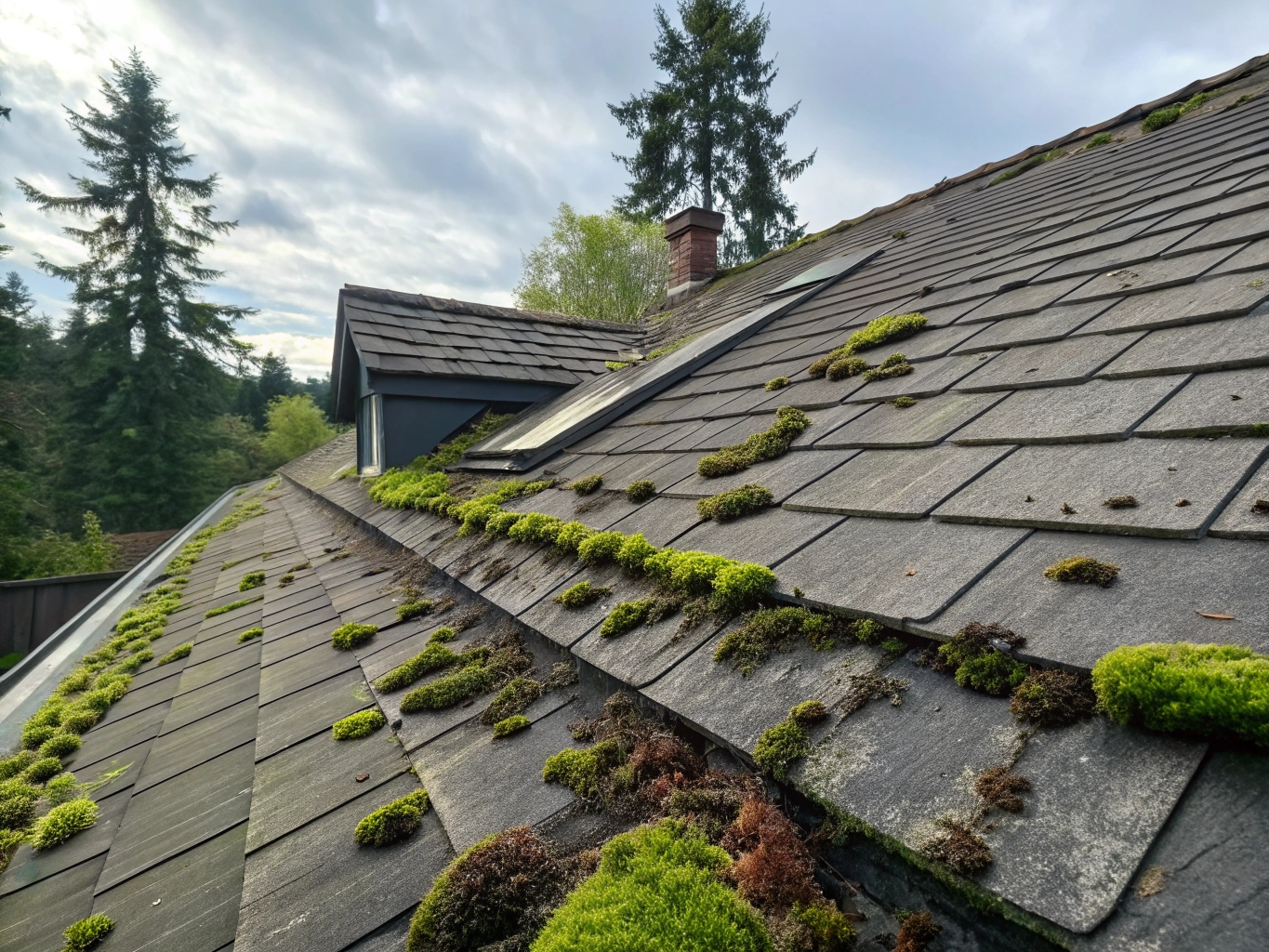
Why is moss such a serious problem on Portland-area roofs?
Moss thrives in the exact conditions Beaverton, the West Hills, and most of the Portland metro provide year-round:
- Mild temperatures that rarely freeze deeply enough to kill moss
- Sustained moisture — Portland averages 36 inches of rain across roughly 155 rainy days per year
- Heavy tree canopy keeping roofs shaded and damp longer
- Organic debris from Doug firs, big-leaf maples, oaks, and cedars feeding moss with continuous nutrients
- Air quality that doesn’t dry roofs aggressively between rain events
- 150+ overcast days annually preventing UV exposure that would inhibit moss in sunnier climates
This isn’t an aesthetic problem. Moss actively damages your roof through several mechanisms:
How moss damages roofs
- Shingle lifting. Moss grows underneath shingle edges, gradually lifting them. Lifted shingles are vulnerable to wind, lose their watertight overlap, and break.
- Moisture retention. Healthy moss can hold 20+ times its weight in water. That water sits against the shingle surface for extended periods between rain events, accelerating granule loss and asphalt degradation.
- Granule loss. The protective granule layer on asphalt shingles is what blocks UV damage to the asphalt itself. Moss accelerates granule loss; once granules are gone, shingles fail rapidly.
- Acidic effects. Decomposing organic matter under moss creates mildly acidic conditions that accelerate degradation of asphalt, metal flashing, and even concrete tile bedding.
- Water diversion. On tile roofs, moss buildup at tile overlaps directs water sideways under the tiles, defeating the overlap waterproofing system.
- Underlayment exposure. Where moss has lifted shingles enough that wind tears them off, the underlayment beneath gets exposed to UV and weather it wasn’t designed to handle.
- Ice dam contribution. In winter, moss-covered sections trap snow and create thaw/freeze cycles that contribute to ice dams on lower roof edges.
Actual lifespan impact
A 30-year architectural shingle roof in Beaverton with zero moss management will typically fail at 18 to 22 years — losing roughly a third of its expected lifespan. With proactive moss management (zinc strips + treatment every 3 years), the same roof can hit or exceed its 30-year expected lifespan. Over the life of one roof, that’s a difference of $4,000 to $8,000 in advanced replacement costs, or roughly 20× the cost of regular moss treatment.
What does roof moss actually look like at different stages?
Stage 1: Algae staining (early warning)
Black streaks running down north-facing sections of the roof. This is Gloeocapsa magma algae, often the precursor to moss. Cosmetic at this stage, but a signal that conditions are right for moss to follow within 1 to 3 years.
Stage 2: Light moss growth
Small green clumps, typically along shingle edges, in valleys, and on north-facing sections. Easy to remove at this stage, no lasting damage yet.
Stage 3: Established moss colonies
Thick green mats covering significant roof areas. Visible from the ground. Beginning to lift shingle edges. This is where damage starts compounding and where most homeowners finally notice.
Stage 4: Aggressive moss with visible damage
Moss is multiple inches deep in places, shingles are visibly lifted or curled, granule loss is apparent, and underlying shingle damage may already be irreversible. Cleaning is still worthwhile but some shingle replacement may also be needed.
Stage 5: Moss-accelerated roof decline
Active leaks, widespread shingle damage, exposed underlayment, and decking damage in some cases. At this stage, moss removal is part of preparing for a roof replacement, not avoiding one.
If you’re at stage 1 or 2, prevention is cheap and easy. If you’re at stage 3 or 4, professional remediation is worth doing immediately. If you’re at stage 5, the roof itself is the question — moss treatment isn’t the answer anymore.
How do you actually remove moss from a roof?
What works
1. Manual brushing with a soft-bristle brush.
Gentle physical removal of moss colonies, working downhill (with the shingle grain) so brush strokes don’t lift shingles. This is slow, careful work — typically several hours for a 2,000 sq ft roof.
2. Targeted treatment with a moss-killing solution.
Zinc sulfate-based products are the gold standard for asphalt shingle roofs. Sprayed on dry roof, allowed to penetrate, then either rinsed gently or left to weather off (depending on product). Treatment kills existing moss and inhibits regrowth for 1 to 3 years.
3. Professional soft-wash.
Low-pressure (under 100 psi — comparable to a garden hose) application of biodegradable cleaning solution, allowing the chemistry to do the work rather than mechanical force. Safe for asphalt, tile, and most other roofing materials when done correctly.
4. Compressed air debris removal.
Some PNW maintenance specialists use leaf-blower-style compressed air to remove loose debris and dead moss without water, useful for older roofs where even gentle water might cause issues.
What doesn’t work (and what damages your roof)
- Pressure washing. This is the single biggest mistake homeowners make. High-pressure water blasts off shingle granules, drives water under shingles into the underlayment, lifts shake or shingle edges, and can shatter concrete tiles. A pressure-washed roof can lose 5+ years of remaining lifespan in a single afternoon. Never pressure wash a roof.
- Bleach (chlorine). Damages metal flashing, kills landscaping when it runs off, irritates skin and eyes, and is environmentally problematic. Some commercial products use diluted bleach safely, but DIY bleach treatments cause problems regularly.
- Scraping with metal tools. Removes moss but takes shingle granules with it.
- Powerwashing followed by leaving it. Even if you got the moss off, you exposed the shingles to high-pressure damage and didn’t address regrowth conditions.
- Just spraying treatment on heavy moss without removing it first. Treatment kills moss, but dead moss still holds moisture and still lifts shingles. Removal + treatment is the right sequence.
- Walking around on a wet, mossy roof. Beyond personal safety, foot traffic on saturated, mossy shingles compresses and damages them.

How do you prevent moss from coming back?
Zinc and copper strips at the ridge
The single most effective long-term prevention. When rain hits zinc or copper, dissolved metal ions wash down the roof and inhibit moss/algae growth across the surface below. Zinc is more affordable; copper lasts longer and works on shake roofs as well.
For a 2,000 sq ft Beaverton home, zinc strips at the ridge cost $300 to $800 installed. They reduce — though don’t completely eliminate — moss regrowth for 15 to 25 years. We install zinc as part of most new roof projects in this area because the math is dramatically in the homeowner’s favor.
Periodic professional treatment
Every 2 to 4 years depending on tree exposure and roof type. Treatment maintains moss-inhibiting chemistry on the roof surface between zinc-strip rains.
Tree trimming
Cutting back overhanging branches that drop needles and shade the roof. Even modest trimming — 4 to 6 feet of clearance from the roof — dramatically reduces moss conditions. Coordinate with a certified arborist; aggressive tree work can damage long-term tree health.
Gutter and debris management
Annual or biannual gutter cleaning, ridge and valley clearing of debris, and prompt removal of fallen branches keeps moss food sources off the roof.
Choosing moss-resistant roofing materials
If you’re replacing your roof, this is the time to think about moss susceptibility. Metal roofing resists moss almost completely. Algae-resistant architectural shingles (GAF Timberline HDZ with StainGuard, CertainTeed Landmark with StreakFighter) include copper-infused granules that inhibit algae and moss. Composite synthetic slate or shake resists moss far better than real cedar or tile. The material choice you make today affects your moss exposure for the next 25 to 70 years.
How much does professional moss removal and treatment cost in Beaverton?
| Service | Cost Range |
|---|---|
| Light moss removal + treatment (early stage) | $400 – $700 |
| Standard moss removal + treatment (established moss) | $600 – $1,200 |
| Heavy moss removal + multiple treatments (severe) | $1,000 – $2,500 |
| Add zinc strips at ridge (one-time) | $300 – $800 |
| Annual maintenance plan (cleaning + treatment) | $300 – $600/year |
| Combined roof + gutter cleaning | $500 – $1,000 |
For most Beaverton homes, an initial professional cleaning ($600 to $1,200) plus zinc strip installation ($300 to $800) plus retreatment every 3 years ($400 to $700 each time) gives you complete moss management for roughly $200 to $400 per year amortized — a tiny fraction of the roof replacement cost it prevents.
Should I do moss removal myself or hire a professional?
DIY is reasonable when:
- Moss is light (early stage)
- Your roof has a low pitch and good footing
- You have proper safety equipment (harness, ladder stabilizer, soft-soled shoes)
- You’ll use the right products (zinc-sulfate-based) and right tools (soft-bristle brush)
- You can dedicate the time to do it right
Hire a professional when:
- Moss is established (stage 3+)
- Your roof is steep, complex, or two stories+
- You have tile, cedar shake, or composite roofing (specialty cleaning techniques)
- You don’t have proper safety equipment
- The economics work out better than the time/risk you’d put in
Honest assessment: most Beaverton homeowners are better off hiring this work out. The combination of slick PNW shingles, steep roof pitches in our hilly terrain, and the specialized products that work best makes professional service the better economic choice for most. Treat it like furnace tune-ups or chimney sweeping — a regular maintenance task you outsource.
What’s the best time of year for roof moss removal in Beaverton?
Best window: late spring through early fall (April through October) when extended dry periods let treatments work properly and roofs are safer to access.
Worst window: November through February when constant rain prevents treatments from drying onto the roof and creates dangerous slick conditions.
Many Beaverton homeowners schedule moss work in May or June (catching what grew through winter) and again in September or October (before fall leaf-fall starts). Some do annual September treatments. Whatever your schedule, doing it during the rainy months is rarely productive.
Frequently Asked Questions
Why is roof moss such a problem in Portland and Beaverton?
The Pacific Northwest’s mild temperatures, 36+ inches of annual rainfall, heavy tree cover, and 150+ overcast days per year create ideal moss conditions year-round. Moss thrives in this environment in ways it doesn’t in drier or sunnier climates, and untreated PNW moss can shorten an asphalt roof’s life by 5 to 15 years.
Will moss really damage my roof, or is it just cosmetic?
Moss actively damages roofs by lifting shingles, holding moisture against the roof surface, accelerating granule loss, creating leak paths, and contributing to ice dams. Damage progresses slowly but compounds — a cosmetic moss problem at 5 years is structural damage by 12 years if untreated.
Can I just power wash moss off my roof?
Never. Pressure washing damages asphalt shingles by stripping protective granules, drives water under shingles into the underlayment, can shatter concrete tiles, and lifts shake or shingle edges. A pressure-washed roof can lose 5+ years of remaining lifespan in a single afternoon. Use brushing and treatment instead.
What kills moss on a roof?
Zinc-sulfate-based moss treatments are the gold standard for asphalt roofs and most other materials. Some products are formulated for specific roof types (cedar shake has its own appropriate treatments). Avoid bleach-based DIY mixtures — they damage flashings and harm landscaping.
Do zinc strips actually work to prevent roof moss?
Yes, when properly installed at the ridge. Rain dissolves zinc ions which wash down the roof and inhibit moss/algae growth. Zinc strips reduce moss regrowth significantly for 15 to 25 years and are a cost-effective preventive investment ($300 to $800 installed for most Beaverton homes).
How often should I have my roof treated for moss in Beaverton?
Every 2 to 4 years for most Beaverton homes, depending on tree exposure. Heavily shaded lots in West Hills, Cedar Mill, and Raleigh Hills may need annual treatment. Sunnier lots in Bethany or Cooper Mountain may stretch to 4-year intervals.
How much does professional roof moss removal cost?
$400 to $1,200 for most Beaverton homes depending on roof size and moss severity. Heavy moss with multiple treatments runs $1,000 to $2,500. Adding zinc strips at the ridge is a one-time $300 to $800 investment that dramatically reduces ongoing treatment frequency.
Can my homeowner’s insurance cover moss damage?
Generally no. Moss damage develops over time and is considered a maintenance issue rather than sudden damage. Insurance covers wind damage, fallen tree damage, and other sudden events — not the gradual deterioration that moss causes. Document moss management as part of regular home maintenance.
Is there a roofing material that doesn’t get moss?
Standing seam metal resists moss almost completely — debris and moisture slide off rather than supporting growth. Stone-coated steel performs similarly. Algae-resistant architectural shingles with copper-infused granules (GAF Timberline HDZ, CertainTeed Landmark with StreakFighter) resist algae and moss far better than basic shingles. Composite synthetic shake/slate resist moss well. Real cedar shake and concrete tile are the most moss-susceptible.
Should I get my roof cleaned before selling my Beaverton home?
Yes, almost always. Visible moss is one of the most common items called out in Portland-area pre-sale inspections, and buyers often request roof concessions if moss is present. A $600 to $1,000 cleaning before listing typically returns multiple times that in faster sale and stronger negotiating position.
Will trimming my trees back stop roof moss?
It dramatically reduces moss conditions. Even 4 to 6 feet of clearance between branches and the roof improves sun exposure, air circulation, and reduces the constant supply of organic debris that feeds moss. Coordinate tree work with a certified arborist to protect long-term tree health.
Get a Roof Moss Assessment from a Beaverton Roofer
Moss management is dramatically cheaper than the roof replacement it prevents. If you’re seeing green on your Beaverton roof — even early algae streaking — it’s worth a free assessment to see what stage you’re at and what makes sense to do about it.
Raven Roofing Beaverton offers free roof inspections including moss assessment, photo documentation of any damage, honest recommendations on cleaning vs. repair vs. replacement timing, and zinc strip installation for long-term moss prevention.
Request a Free Roof Inspection
📞 Call 503-783-8855 or request a free roof inspection online.
Raven Roofing Beaverton LLC
4145 SW Watson Ave #350, Beaverton, OR 97005
Oregon CCB #257909 | GAF Certified Plus | CertainTeed Shingle Master | BBB Accredited