“`html
Metal Roof Repairs in the Portland Metro: Why Most Companies Won’t Do Them, and What They Actually Cost
By Aaron Cope, Owner, Raven Roofing Beaverton — Last updated May 2026
TL;DR: Simple metal roof repairs in the Portland metro typically run $500 to $1,500 — sealing a small flashing issue, extracting and replacing a single accessible panel, addressing isolated fastener problems. But here’s the honest reality: if a metal roof needs repair outside of clear storm damage or impact damage from a fallen branch, the underlying problem is almost always installation, design, or ventilation — and the right answer is often replacement, not repair. Most companies don’t offer metal repair because the work is genuinely hard, replacement panels rarely match the original, and homeowners are rarely happy with the result. We do offer metal repairs when they make sense, and we tell you honestly when they don’t.
Why choose us for metal repairs
Metal roofing is a specialty. The skill set required to install metal correctly — and to repair it well when something goes wrong — is dramatically different from asphalt or even tile work. Most Portland-area roofers don’t take metal repair calls because:
- Pulling apart metal panel systems for repair is technically difficult, especially mechanically seamed standing seam systems
- Replacement panels rarely match the originals due to discontinued profiles, color fading, or supplier changes
- Homeowners are typically unhappy with the visible mismatch, even when the repair is structurally sound
- The work is slower and lower-margin than installation
- The skill required to do it right takes years to develop
We handle metal repair work because Josh has 16 years of multi-system roofing experience including extensive metal work — both as a hands-on installer in his earlier years and as a project manager during his 9 years in estimating and project management before we started Raven. Josh runs production and handles the technical decisions on every metal job; he understands metal roofing systems at the level required to assess what’s actually wrong and whether repair or replacement is the right answer. Aaron Cope handles estimates, customer communication, and insurance documentation — his background as a former roofing insurance adjuster matters when metal damage is storm-related, because documenting wind or impact damage in the format adjusters need is its own skill.
We’re also direct with homeowners about when metal repair isn’t the right answer. If your metal roof is failing because it was installed wrong, the repair will fail too, and we’d rather tell you that than take your money for work that won’t solve the problem.
What does metal roof repair cost?
Simple metal repairs: $500 – $1,500
When metal repair is genuinely the right answer, simple repairs cover work like:
- Sealing a small accessible flashing issue at a vent, pipe, or transition
- Extracting and replacing a single damaged panel where access allows
- Addressing isolated fastener problems on exposed-fastener systems
- Localized seal repair at penetrations
- Reseating loose ridge or hip cap
These prices apply when access is reasonable and the repair scope is genuinely localized — meaning the rest of the metal system isn’t compromised.
Larger metal repairs: $1,500 – $5,000
When the repair scope expands but stays under “system-level” issues:
- Multi-panel replacement on an accessible section
- Comprehensive flashing rework around a chimney, skylight, or transition
- Larger storm damage repair on an exposed-fastener metal system
- Fastener replacement across a section of older exposed-fastener panels
Why “$15,000 metal repairs” usually become replacements
When metal damage extends across larger areas, when the underlying cause is installation rather than impact, or when accessing the damaged section requires removing significant amounts of intact panel, the math typically shifts in favor of replacement rather than continued repair. We’ll show you the analysis, but most metal “big repairs” we evaluate end up as replacement projects.
The honest truth about why metal roofs need repair
Outside of clear storm damage or impact damage from a fallen branch, metal roofs that need repair almost always have an underlying installation problem. This is a hard truth most contractors won’t tell you, but it’s the reality of how metal systems work.
A correctly installed metal roof should perform for 40 to 70 years with effectively zero maintenance and no leaks. When a 7-year-old metal roof is leaking, it’s not because the metal failed — it’s because something about the installation, design, or ventilation didn’t account for how metal systems actually work in PNW conditions.
The most common installation failures we see:
1. Inadequate ventilation top-to-bottom.
Metal panels collect condensation on the underside when warm, moist attic air contacts cool metal. Without proper continuous ventilation from soffit intake to ridge exhaust, that condensation drips onto insulation and into the home below. The roof appears to “leak” even though water is never penetrating from above.
2. Missing baffles in insulation.
Insulation packed tight against the underside of the roof deck blocks air movement and traps moisture. Proper installation requires baffles that maintain a continuous air gap between the insulation and the roof deck.
3. Wrong panel choice for the slope.
Standard panels designed for steeper slopes don’t perform on low-slope applications. Mechanical seam (MS) panels are required for low slopes; standard interlocking panels in those applications eventually leak at every seam.
4. Flat pan panels on long runs.
Long unsupported flat pan panels develop “oil canning” — visible waviness from thermal expansion, transport stress, or unlevel substrate. We don’t install flat pan unless the customer specifically requests it and signs a waiver acknowledging the visual risk. Industry-standard ribs or striations stabilize panels and reduce oil canning dramatically.
5. Exposed fasteners on a system that shouldn’t have them.
Standing seam metal is engineered with concealed fasteners specifically because exposed fasteners are the typical failure point. When a contractor installs flashings under the panels and tries to seal them with silicone — something we’ve literally seen in the field — they’re defeating the engineering of the entire system. The phrase we use: “if you can’t flash it properly, don’t install it.”
6. Wrong gauge or thickness for the application.
We recommend 24-gauge metal with ribs or striations for the texture, plus 12-inch panels for extra stability on 20-foot or longer runs. Thinner gauges are often used to save cost but become problematic on long runs and unlevel surfaces.
7. Improper hook eaves or perimeter detail.
Hook eaves are the proper detail for a standing seam system — they let the panel attach correctly without screw penetrations through the metal. Many metal roofs we inspect were installed with screws through the panels at the eaves, which creates penetrations that fail over years of thermal cycling.
When any of these underlying issues are present, you can repair the visible leak point, but the system will continue failing in new locations. That’s why metal repair is sometimes the right answer and often isn’t.
A real Portland-area metal failure (and how we solved it)
We recently replaced a metal roof that was 7 years old. Here’s what was happening:
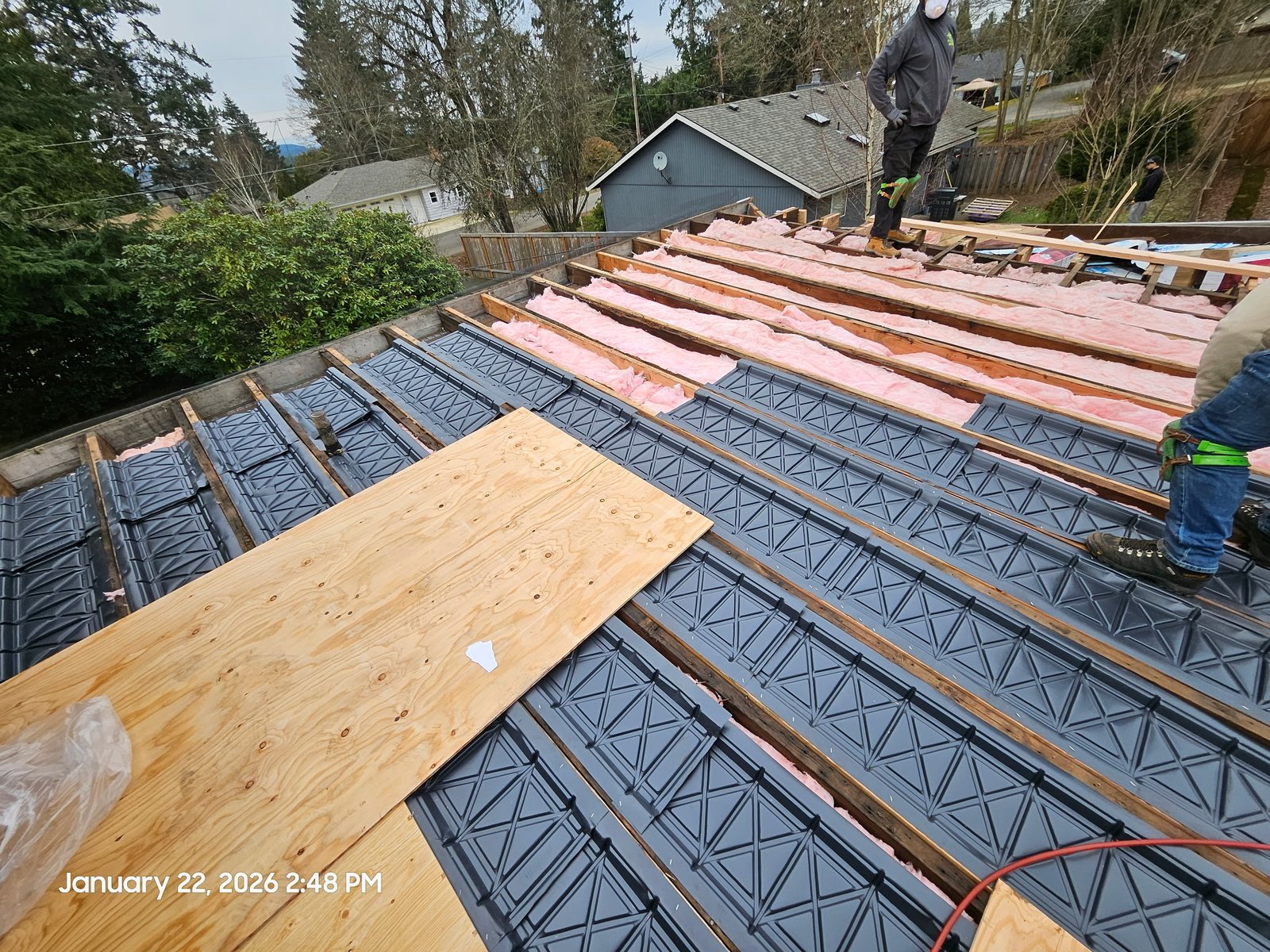
The roof was installed with EZ-lock panels on a low slope. The insulation didn’t have baffles, so there was no air gap between the insulation and the roof deck. There was no ventilation top to bottom — no soffit intake, no ridge exhaust, nothing to move air through the system. All the panels started sweating from condensation underneath, and the whole house started leaking. From inside the home it looked like a roof leak; from above the panels looked fine.
This is exactly the failure pattern we see most often on metal roofs that “leak” without obvious external cause.
What we did to actually solve the problem:
- Replaced all the rotten plywood that had decayed under years of condensation
- Added baffles for continuous airflow from the insulation to the roof deck
- Installed continuous soffit intake vents to start the air movement at the bottom
- Installed 14-inch clerestory metal with butyl-taped filters for ridge ventilation, which prevents debris from getting into the roofing system over years
- Installed valleys with cleats that hold the valley in place and lock the whole system together
Most contractors don’t install valley cleats and don’t butyl-tape ridge filters. Both details matter for a 50-year roofing system. The first lets you achieve a 40-70 year service life on the roof system itself; the second prevents a slow attic clog that compromises ventilation 10-15 years after installation.
The previous installer wasn’t malicious — they probably installed the metal correctly per panel-installation instructions. They just didn’t think about the system as a whole, didn’t account for PNW condensation realities, and didn’t know about details like butyl-taped ridge filters or valley cleats.
When metal repair is genuinely the right answer
Repairs make sense on metal when:
- The damage is from a clear external event — fallen branch, hail event (rare in our climate but possible), wind-thrown debris
- The repair is genuinely localized — one panel or one flashing point, with surrounding system intact
- Access is reasonable — the damaged area can be addressed without disassembling significant intact panel runs
- The underlying system was correctly installed — proper ventilation, correct panel choice for slope, intact perimeter details
- Replacement panels can be reasonably matched — same profile, similar color (some weathering acceptable)
When all five conditions are met, simple metal repair is straightforward and effective.
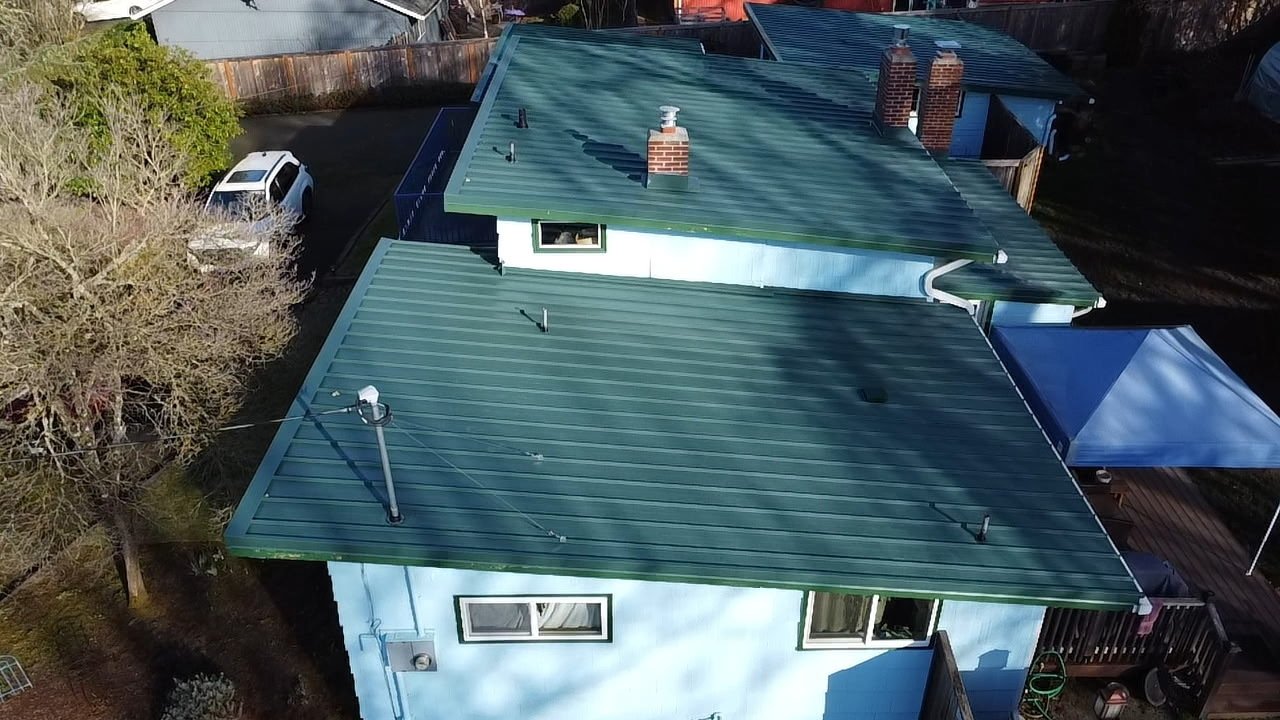
When metal repair becomes “the system needs replacement”
Replacement is the honest answer when:
The underlying issue is installation.
No repair will fix a roof that’s failing because of inadequate ventilation, missing baffles, wrong panels for the slope, or flat pan oil canning. The new repair will fail in 2-5 years for the same reasons the original failed.
The system is mechanically seamed.
Mechanical seam panels are extremely difficult to pull apart for repair because the seam itself is a permanent mechanical lock. You can’t pop it open and replace one panel; you have to take all the panels off together to access any one of them.
One bad panel requires removing the entire slope.
Some metal systems are designed so that panel removal cascades — you can’t get to panel #4 without removing panels #1-3, then reinstalling them. On long runs this means replacing one panel effectively means working with the entire slope.
Replacement panels can’t be matched.
Color fading over years means even a “matching” panel looks different from the surrounding aged panels. On a visible roof, the visible mismatch is usually unacceptable to homeowners.
The metal is older with discontinued design.
Profiles change. Older metal designs are often hard to source replacements for, and substitutes don’t seat correctly with the existing material.
Why insurance companies don’t love metal roofs in heavily wooded areas
This is something most homeowners don’t know: insurance carriers have started flagging metal roofs in heavily-wooded PNW neighborhoods because metal repairs after tree damage are difficult, expensive, and frequently lead to replacement rather than repair. From the insurer’s standpoint, a fallen branch on an asphalt roof is a $1,500 patch repair; the same branch on a metal roof can become a $20,000 partial replacement because of the panel-cascade issue.
This doesn’t mean metal is the wrong choice in heavily-wooded areas — metal still has significant advantages in moss resistance, longevity, and energy efficiency. It does mean that if you’re choosing metal in an area with significant tree canopy (West Hills, Cooper Mountain, certain Cedar Mill and Raleigh Hills lots), you should plan accordingly: keep trees trimmed back from the roof, document your roof condition periodically with photos, and make sure your insurance policy covers replacement-cost not actual-cash-value on roofing damage.
What metal repair work includes from Raven
When we handle metal repair, we include:
- Comprehensive system inspection — not just the visible damage, but assessment of ventilation, baffles, panel choice, and perimeter details to determine whether repair will actually solve the problem
- Honest assessment of repair vs. system replacement with documented reasoning
- Insurance documentation when damage is storm or impact-related
- Source matching attempts for replacement panels, including color and profile evaluation
- System detail audit — if we identify ventilation, baffle, or design issues during the repair inspection, we’ll explain what would actually solve the problem long-term
- Photo documentation of issues found and work completed
Frequently Asked Questions
How much does metal roof repair cost in the Portland metro?
Simple repairs range $500-$1,500 (sealing accessible flashing issues, extracting and replacing a single panel, isolated fastener problems). Larger repairs run $1,500-$5,000. When repair scope expands beyond that, the math typically favors system replacement rather than continued repair.
Why do most companies not offer metal roof repair?
Three reasons: the work is genuinely difficult (especially on mechanically seamed systems where panels can’t easily be pulled apart for repair), replacement panels rarely match the originals due to discontinued profiles or color fading, and homeowners are usually unhappy with the visible mismatch even when the repair is structurally sound. The work is also slower and lower-margin than new installation, which most contractors prioritize.
If my metal roof is leaking, why is replacement often the right answer?
Because metal that’s failing — outside of obvious storm or impact damage — is almost always failing due to underlying installation, design, or ventilation issues. The visible leak is a symptom; the cause is the system. Repairing the symptom doesn’t fix the cause, so the roof keeps failing in new locations. We’ll diagnose the underlying issue and tell you honestly whether repair or replacement actually solves your problem.
What causes metal roofs to leak when they’re only a few years old?
Most commonly: inadequate ventilation creating condensation under the panels, missing insulation baffles preventing airflow, wrong panel choice for low slopes, flat pan panel oil canning on long runs, exposed fasteners that have failed, or improper flashing details. We’ve seen 7-year-old metal roofs sweating condensation through every panel because of installation errors that had nothing to do with the panels themselves.
What’s the difference between standing seam, exposed-fastener metal, and mechanically seamed panels for repair purposes?
Exposed-fastener systems are the easiest to repair because you can address fasteners and panels individually. Standing seam with concealed fasteners is moderately difficult — you can work with adjacent panels but the panel sequence matters. Mechanically seamed standing seam is genuinely very difficult to repair because the seam is a permanent mechanical lock that can’t easily be opened — you have to take panels off together to access any one of them.
Will my insurance cover metal roof repair?
Storm damage from wind events, fallen trees, hail, or other sudden impact is generally covered. Wear-and-tear, installation defects, and ventilation-related leaks aren’t covered events under most policies. Aaron’s background as a former roofing insurance adjuster helps document storm-related metal damage in the format adjusters expect, which improves claim approval and accurate scope.
My roof is missing some panels after a windstorm — is that an insurance claim?
Yes, almost always. High-wind events causing missing or damaged panels are a covered event under most homeowner policies. If you’re seeing missing panels or pulled-up edges after wind, document immediately with photos, file a claim, and have us provide a professional assessment. Wind damage to metal is one of the clearer insurance claim categories.
Can I repair an EZ-lock or interlocking metal panel system?
Sometimes, with significant difficulty. Interlocking systems require working with adjacent panels to replace any one, and access to internal areas often requires removing multiple panels and reinstalling. The work is feasible but time-intensive, and we evaluate whether the repair scope and resulting visual match make economic sense versus partial or full replacement.
Is metal roofing still a good choice for PNW homes despite these repair complications?
Yes — metal remains an excellent choice for PNW homes when installed correctly. The longevity (40-70 years), moss resistance, low maintenance, and energy efficiency are real advantages. The complications come into play primarily when metal isn’t installed correctly to begin with, or when storm damage occurs in heavily-wooded areas. Choose a contractor who understands metal systems as systems, not just panel installation, and the repair-complication concerns are largely manageable.
What metal roof details should I make sure my contractor includes?
Hook eaves rather than face screws, 24-gauge minimum with ribs or striations for stability, 12-inch panels on long runs (20+ feet), continuous soffit intake plus ridge exhaust ventilation, baffles in insulation for airflow, valley cleats to lock the system in place, butyl-taped ridge filters to prevent debris infiltration, no exposed fasteners on the field, and proper flashing detail at every penetration. Ask the contractor to walk you through each of these specifically. Vague answers signal vague execution.
Get an Honest Metal Roof Assessment
If you have a metal roof in the Portland metro that’s giving you problems — leaks, condensation issues, panel damage, or system concerns — we’d rather come look than guess. Free inspections include comprehensive system assessment (not just visible damage), photo documentation, an honest analysis of repair vs. replacement, and a written quote you can compare to anything else.
📞 Call 503-783-8855 or request a free inspection online.
Raven Roofing Beaverton LLC
4145 SW Watson Ave #350, Beaverton, OR 97005
Oregon CCB #257909 | GAF Certified Plus | CertainTeed Shingle Master | BBB Accredited
Serving Beaverton, Hillsboro, Tigard, Aloha, Lake Oswego, West Linn, Tualatin, Sherwood, and the greater Portland metro.
“`